
Madhya Pradesh, a state in central India known for its diverse geography, faces significant challenges in ensuring safe faecal sludge management. While commendable progress has been made in achieving open defecation-free status, the majority of the state’s population, primarily residing in rural areas, continues to lack access to safe and effective sludge management solutions. To address this issue in a region characterized by a wide range of settlement types, a focused project has been initiated. It prioritizes the identification of 30 towns across Madhya Pradesh, which will serve as pilot areas for the comprehensive design and implementation of faecal sludge management (FSM) strategies, aiming to bridge the gap in sanitation services and improve public health outcomes.
WaterAid India
May 2023
30 GPs of Madhya Pradesh, India
The project is designed to address the specific sanitation challenges found in the diverse rural areas of Madhya Pradesh. Its primary goal is to create tailored and sustainable sewage management solutions through the use of cluster-level treatment methods and efficient collection systems. The central focus is on implementing location-specific strategies, with an initial emphasis on identifying 30 priority Gram Panchayats (GPs). These selected GPs will act as pilot areas for the detailed design and implementation of Faecal Sludge Management (FSM), which includes establishing treatment plants. The choice of these GPs will be based on a set of criteria to ensure that they are the most suitable locations for implementing these interventions.
The goal is to establish a solid groundwork that will facilitate the preparation and approval of an investment loan from the Agence Française de Développement (AFD), a crucial step in facilitating the project.
A framework was developed to prioritize 30 Gram Panchayats (GPs) for system implementation, utilizing GIS-based spatial analysis for location suitability assessments.
Rapid technical assessments, including consultations and data collection, were conducted to comprehend the challenges and opportunities in selected GPs, offering vital insights for sanitation planning.
Fact-files and presentations were created for each GP, detailing Faecal Sludge (FS) treatment options, leading to financial assistance from the Government of India, supporting sanitation initiatives in prioritized GPs.
The project recommended diverse sanitation modules, considering options like clustering, standalone systems, FS management, and combined FS with greywater management, customized to each GP's specific needs.
Technology solutions were identified to address sanitation challenges in selected GPs and preliminary cost estimates were determined, offering insights into the financial requirements for solution implementation.
The project secured funding from the Moi, advancing into the implementation phase. Prioritized GPs are now proceeding with sanitation initiatives, guided by the project's recommendations and financial support.
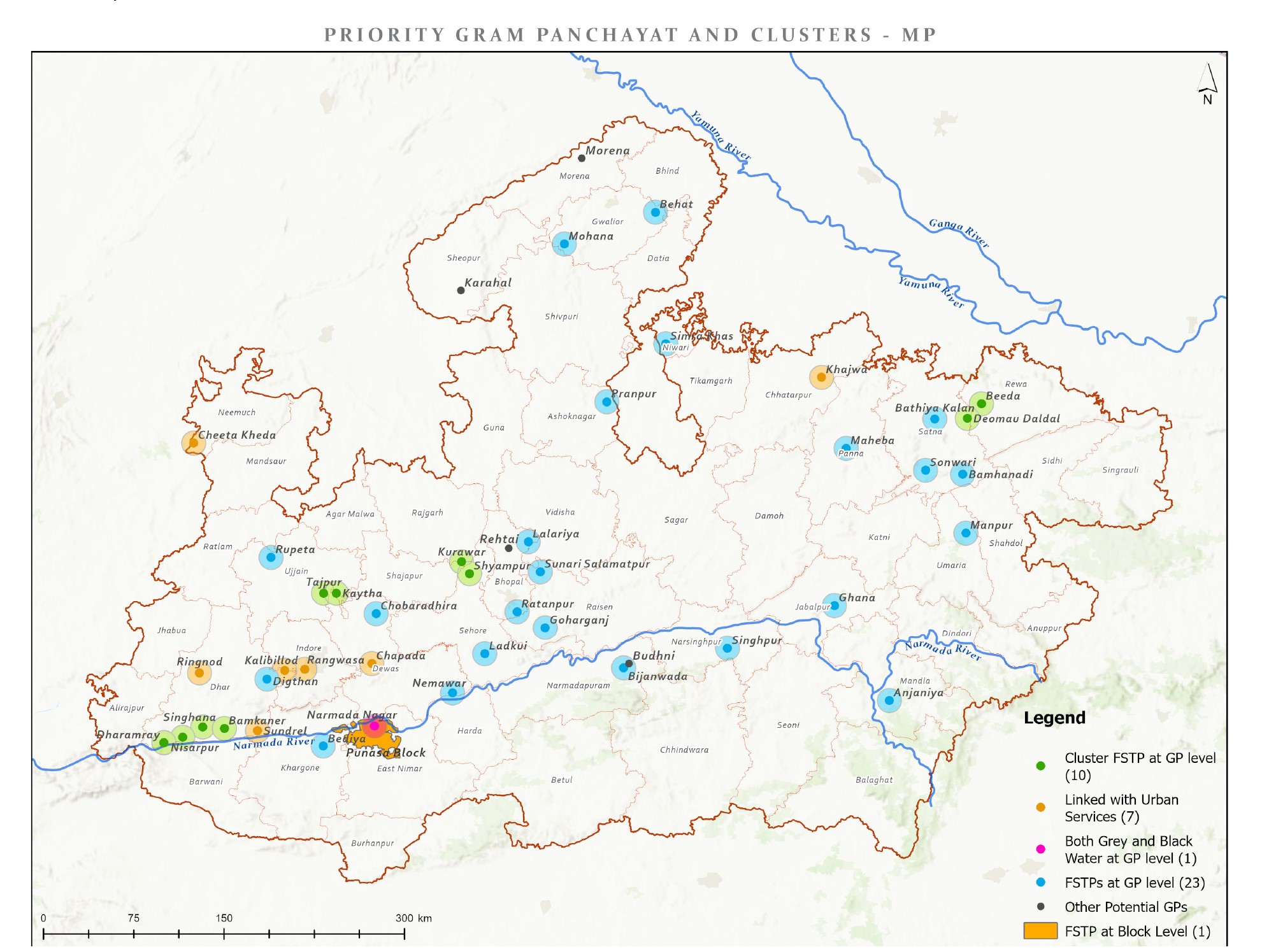
The Map illustrates the identification of Priority Gram Panchayats (GPs) for the phased implementation of sanitation systems across the state of Madhya Pradesh. The listing is the result of a comprehensive evaluation process, involving parameters such as population, block density proximity to tourist locations, industries, ground water table, proximity to water bodies, flood risks, and proximity with urban services.