
Rajasthan’s urban landscape spans arid and semi-arid regions marked by dispersed settlements, rapidly expanding peri-urban areas, and high climatic variability. Across the participating towns, household sanitation predominantly depends on on-site systems, with septic tanks and pits forming the core containment infrastructure. While recent investments have established multiple Faecal Sludge Treatment Plants (FSTPs) across the state—both thermal and passive—their utilisation remains low due to irregular desludging practices, limited public awareness, unregulated operators, and weak service linkages.
The region’s challenging hydrogeology, high summer temperatures, and occasional flash-flood conditions further influence the operational reliability of sanitation systems. Consultations across Urban Local Bodies (ULBs) reveal that desludging is largely emergency-driven, resulting in unsafe disposal, non-compliant emptying cycles, and inconsistent inflow to FSTPs. These factors underline the need for a structured, climate-aware, behaviourally informed sanitation strategy that improves service delivery while strengthening regulatory and operational systems across towns in Rajasthan.
Directorate of Local Bodies (DLB), Government of Rajasthan
2024–2025
Multiple ULBs across Rajasthan, India
The project aims to redesign and strengthen the sanitation service chain with an emphasis on scheduled desludging, improved FSTP utilisation, operator regulation, and digital monitoring. The scope includes assessing behavioural barriers, identifying desludging gaps, developing incentive-based service models, proposing tariff reforms, improving private operator compliance, and strengthening sludge conveyance pathways.
The initiative integrates spatial data, operational diagnostics, behaviour change insights, and policy recommendations to create a citywide framework for safe containment management. Its objective is to build a predictable, environmentally safe desludging system that ensures steady treatment inflow, enhanced public health outcomes, and financially viable operations for ULBs.
The project team delivered a holistic solution involving desludging diagnostics, stakeholder consultations, operator ecosystem mapping, and detailed assessments of containment practices. Spatial and operational data were analysed to identify critical gaps and prioritise interventions across ULBs.
Although Rajasthan faces limited large-scale flooding, several low-lying pockets and settlements near nallahs and natural depressions experience seasonal water accumulation. Area-specific risk assessments informed containment improvement guidelines and desludging prioritisation for vulnerable neighbourhoods.
The team reviewed sanitation systems across towns, assessed FSTP loading patterns, and analysed existing conveyance routes. Recommendations were developed to improve desludging access, regulate private operators, and ensure consistent, safe inflow to both passive and thermal FSTPs.
A fully interactive virtual tour of Rajasthan’s thermal FSTP was developed, featuring an AI-driven chatbot to guide officials, contractors, and operators through plant components, operational steps, safety procedures, and best practices. This tool serves as a continuous learning platform for state-wide capacity building.
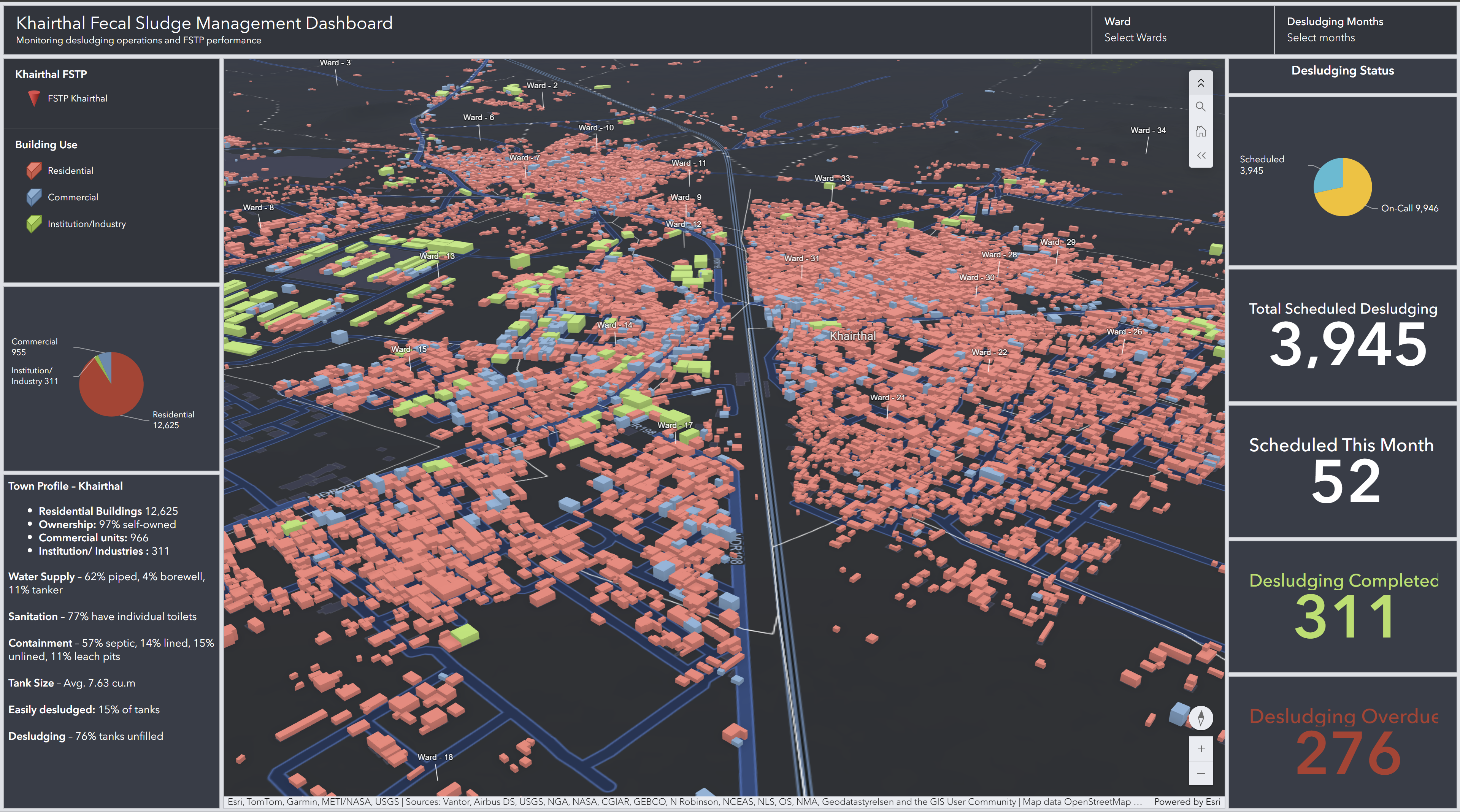
A detailed schematic dashboard framework was created to guide the project contractor in developing spatial, interactive dashboards for all participating towns. The dashboard template outlines data layers, workflows, performance indicators, risk maps, and monitoring features to ensure uniform, high-quality digital reporting across ULBs.
The project introduced actionable reforms including desludging by-laws, penalty structures for illegal dumping, licensing procedures, tariff rationalisation, and monitoring protocols. These recommendations aim to build a resilient, transparent, and accountable sanitation governance system.
The project’s analytical framework combined service chain diagnostics with behavioural insights and spatial assessments to identify desludging challenges across Rajasthan towns. Settlement density, accessibility, operator presence, and containment practices were mapped to reveal areas vulnerable to service gaps and unsafe disposal.
The integrated analysis highlights ULB-specific operational barriers, enabling prioritisation of neighbourhoods for scheduled desludging, targeted IEC, operator regulation, and FSTP loading optimisation. Collectively, these insights form the foundation of Rajasthan’s strengthened CWIS operational model.